Mezcal is the new kid on the block that quickly garnered a cult following due to its unique smokey flavor and handcrafted processes.

Mezcal Expert Guide

What Is Mezcal?

Mezcal is made from wild agave – or maguey – roasted underground and fermented in clay pots or copper stills. Mezcal is still relatively a handcrafted spirit, unlike the modernized Tequila production.

Mezcal is making a statement in international bars with its bold smoky flavor and artisanal process. In some circles, mezcal is even gaining more popularity than its smooth-friend tequila – and it’s becoming more expensive, too.

Like different wine labels and vintages, each brand and batch of mezcal can also have different tastes, sometimes even within the same barrel.

It was Mexico’s best kept secret for years, primarily because most mezcal production is so small that it never leaves the borders of the town they were made in. It’s not uncommon to see numbered bottles from batches of just 60–100L. Also because it was seen as a crude alcohol without much regulation.

Today, you’ll easily find mezcal on the top shelf in restaurants and cocktail bars as it rises as the ‘next big trend.’ Serious interest is catching on, as was seen when Pernod Ricard bought Del Maguey in 2017.

As the Mexican (rhyming) quote suggests, today it is widely enjoyed by everyone, any time:

“Para todo mal, mezcal. Para todo bien, también.

Y si no hay remedio, un litro y medio.”

For everything bad, mezcal. For everything good, as well. And if there’s no remedy, a liter and a half.

Mezcal Facts At A Glance

Mezcal Expert Guide

What Is Authentic Mezcal?

Certification for mezcal is still being defined and less restricted than tequila, but production is somewhat regulated by the Mexican government.

Both tequila and mezcal have been listed with DO or AO status (denomination of origin or Appellation of Origin), like Champagne and Prosciutto, plus Geographical Indication (GI). This means that the territory influences the product.

Mezcal can only be made in specific regions in certain Mexico states: Oaxaca, Durango, Guanajuato, Guerrero, San Luis Potosi, Sinaloa, Tamaulipas, Zacatecas, Michoacan, and Puebla.

Together, they form the world’s largest denomination of origin, above scotch whisky and tequila. Outside of these regions, bottles must be labelled as ‘distilled agave’ or destilado de agave.

In Mexico, mezcal is regulated under Norma Oficial Mexicana (NOM), by the industry body COMERCAM (Consejo Mexicano Regulador de la Calidad del Mezcal, or Mexican Regulatory Council for Mezcal Quality).

By law, mezcal must have a minimum of 80% agave sugar, while the rest can be made up with other sugars. But similar to tequila, the best mezcal is made with 100% agave.
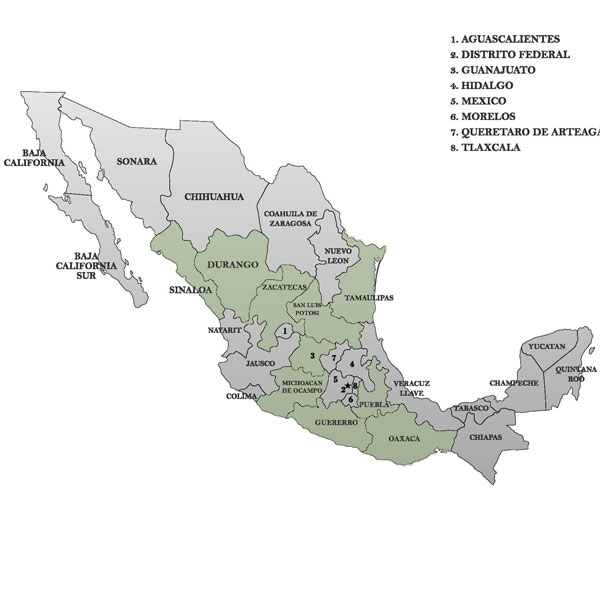
mexico map where mezcal from

Where Is Mezcal From?

Oaxaca is the center of the mezcal world, where some 80% of mezcal is made. Three states overlap where both tequila and mezcal are produced (Guanajuato, Michoacan and Tamaulipas).

Historically, both mezcal and tequila have been made all across Mexico, and the regulations have been somewhat controversial:

  • the high certification cost means small artisanal producers can’t afford to label their authentic alcohol as mezcal. Lots of mezcal never makes it out of local towns.
  • traditional mezcal producers outside of the chosen states were eliminated from the ‘authentic mezcal’ market. Such producers can no longer call their product mezcal. Instead, you might see it called Komil, a Nahautl word for intoxicating drink, or ‘distilled agave’ which is increasingly being accepted in the US.

Inside Mexico, you’ll find many mezcal brands that you’ve never heard of. The market is made up of hundreds of small producers which are too small to go commercial. This is changing as demand increases, although usually it is larger companies that buy up small producers’ stock and put their own label on it.

What Is Mezcal Made From?

There is no regulated list of which agaves can be used to make mezcal but an estimated 30 species are accepted. There are more than 200 subspecies of the agavaceae family, and distillation experiments are ongoing.

The only rule is that it can’t be made with the primary material of another DO product, which means mezcal cannot be majority blue agave, which is tequila.

Agave plants take an average of 7 to 15 years to grow, with some taking up to 30 or 40 years, depending on the species and whether they are cultivated or wild.

Mezcal is predominately made using Agave Espadin, although small producers are pushing other varieties to the top of the list, including wild agaves: tobalá, madrecuixe, tobaziche, tepeztate, arroqueño (Agave Americana), jabali, karwinskill and rodacantha.

The Agave Espadin  – ‘smallsword’ –  is easier and quicker to grow, although it still takes 8 to 12 years to mature. It is the most prevalent agave found in Oaxaca.

Which agave is used is largely influenced by what grows best in the area. For example, in Michoacan you can find mezcal with Americana, Inaqidens and Cupreata agaves.

Then there are mezcal subtypes, like pechuga, blanco, minero (from Santa Catarina Mina), cedrón, creme (creamy mezcal). ‘Pechuga’ mezcal, for example, is distilled with meat, spices and fruits to create a unique flavor.

what is mezcal made from
mezcal origin history invention

Historical Origin of Mezcal

The origin of mezcal is cloaked in legend. Stories say a lightning bolt hit an agave plant, cooking and opening it to release the juices. This is why it is called the ‘elixir of the gods.’ Although, it’s unsure whether ancient tribes distilled it.

The agave plant was one of the most sacred plants for indigenous tribes, holding an esteemed position in religious rituals, mythology and economy. Consumption was once reserved for special occasions and the ruling classes. 

With the arrival of the Spanish came distillation knowledge. The agave was initially produced into an aguardiente – translated as ‘fiery water’ – meaning a crude distillation process.

Mezcal is still primarily produced by small family distilleries – sometimes fifth or sixth-generation distillers – using handed-down, century-old knowledge. It is one of the rare spirits that still largely incorporates the same 16th-century techniques, making it one of the most unique and handcrafted spirits you can buy today.

The word mezcal comes from the combination of two Nahuatl words: metl, meaning maguey, or agave, and ixcalli, meaning cooked or baked.

Mezcal Categories

The Consejo Regulador del Mezcal (CRM) defines the aging and production categories for mezcal.

First, mezcal is classified based on how it is made:

  • Mezcal – industrial mezcal made with mostly modern techniques.
  • Mezcal Artesanal – a mix of traditional and modern techniques are used.
  • Mezcal Ancestral – strictly only rudimentary production techniques are used.

Aging time dictates the next three levels of mezcal. The time stages are similar to tequila, although the names are slightly different:

  • Joven, Blanco or Abacado: this is clear, young mezcal, usually bottled straight away or up to two months after distillation.
  • Dorado (golden): usually not an aged mezcal but may use caramel-coloring to look like it.
  • Reposado or madurado: aged in wooden barrels for two to 11 months. You might see Madurado en Vidrio (“matured in glass”) which is a slower process and less evaporation.
  • Añejo: aged for a minimum of one year in wooden barrels.


mezcal different types
how mezcal is made

How Is Mezcal Made?

There are artisinal aspects to the whole mezcal process: growing and harvesting the agave plants; cooking and smoking them; then crushing and extracting the sugars.

Once the pinas are unearthed from the cooking pit, they are moved to a tahona, a crushing stone wheel which is pushed in circles by a person or a donkey or horse.

Like tequila, mezcal is usually distilled twice. The first distillation, known as ‘punta’ (drops or points), comes in at around 37.5 percent alcohol (75 proof), so a second distillation is usually needed to raise alcohol percentage.

It is important to note, however, that not all mezcals are artisanal – some producers have switched to modern production methods to boost flavor consistency, purity and production to meet market demands. This means that brands like Monte Alban or Aliplus are not the same as what you can find in local producers.

You can get a pretty good snapshot of Oaxaca’s small mezcal producers during the International Mezcal Festival, held in the capital city each year to accompany the yearly folk dance festival, Guelaguetza.

Why Is Mezcal Smoky?

When the agaves ripen, a jimador (cutter) uses a coa (a kind of flat-bladed sickle) to slice away the spiky leaves, leaving a core that looks like a pineapple, explaining the Spanish name ‘piña.

With artisanal mezcals, the piñas are cooked in deep, underground pits, which are formed by digging an inverted cone into the earthen ground, and lining it with volcanic rocks.

The process is overseen by a ‘master’ or mezcalero and a small team. A wood fire is reduced to embers or coals at the bottom of the hole, the long process of which heats the volcanic rocks to extreme temperatures. The pit is then filled with piñas, and covered with a layer of earth, forming an underground “smoke oven.”

Over several days up to two weeks, the piñas smoke and carmalize under the watchful eye of a 24-hour crew. It is this slow-cook, smoking process that gives mezcal its distinct smoky flavor – and where flavors can be played with.

mezcal smoky flavor guide
mezcal tasting guide

What Does Mezcal Taste Like?

There is no set flavor profile for mezcal because of the varied effects of terrain on agave taste and the wide variety used. Sometimes wild yeast is used during fermentation, which means even bottles within the same batch can wildly differ.

Mezcal is distinguished by its robust smoky flavor. Your first sip might be overpowered by an alcoholic vapor, or a cheesy or meaty flavor. But a seasoned drinker will then draw out the hints of smoke and layers of flavor.

It is a misconception that all mezcals have dominating smoky flavors; some have an almost smokeless flavor featuring stronger organic notes. These mezcals are light and fruity, with only hints of smoke.

In general, you will identify flavor profiles that are earthy, sweet, raw, and mineral. The surprise is that the flavors retain rich and vivid backnotes of the agaves used.

Mezcals made from espadin, the most common type of mezcal, generally have sweet, long flavors, accompanied by a smoky depth. Espadin tends to absorb more smoke from roasting than other agaves.

Why Is Mezcal Expensive?

Forget machinery and electricity. Mezcal is still a relatively handmade and family affair: think open-air distilleries, rustic facilities and ancient techniques. Some palenques (agave farms) open their doors to those who want to take a peek, especially in Oaxaca.

The handcrafted production limits mezcal production somewhat. It’s not unusual to find batches of mezcal of only 60–80L.

The method of production is largely inefficient, but the beauty behind it evokes a nostalgia that is rare in the alcohol world. Each sip is truly a taste of someone’s handcraft, drawing from earthy flavours only Mexican soil can provide, from a process that hasn’t changed since the 1600s.

By the time you uncork a bottle of Mezcal, it has gone through a lot. Knowing how mezcal is made explains why prices are upwards of $50, $60 or even $100 per bottle among the premium brands.

But the truth is that you can buy mezcal directly from producers for relatively low prices. Mezcal was once the cheap ‘hooch’ of Mexico. In this way, many people are sold on the stories behind mezcal and this enables sellers to put an extremely profitable markup.

Is The Agave Shortage Real?

Agaves are slow-growing plants when compared to plants like corn or grain that grow back every year. It takes about 7 to 10 years for ‘quick-growing’ agaves, like the blue agave and espadin, while other can take upwards of 30 to 40 years.

Without proper planning, the industry fluctuates in vicious circles; mass supply drives down prices and causes farmers to switch crops, only to eventually result in an agave shortage that drives up prices and brings back farmers.

This issue is compounded as rarer types of agave are in hot demand, such as tobala or jabali, which take decades to grow and are usually collected as wild agaave.

With current demand increasing, the shortage could become real in the short-term – and mezcal prices will likely shoot up in protest.

For an idea of production, it takes around 11 pounds (5kg) of agave to make one bottle of tequila, and an average blue agave weights around 110 pounds (50kg). Rarer agaves produce even less.

More Mezcal Guides

© Images are copyright of Mark Bryce (@markbryce_) and Gabriel Sanchez (@igaboi), and reprinted with permission by MEXLocal. The images are from their visit to Lopez Real Mezcal palenque. To reprint this article or ask for an exclusive guest post, just write to us!